
This 100 % Wining Bug for Quotex and Tradowix post is a part of our trend line remaining topic. For First part visit 4 Top Sureshot Pattern in Quotex and Tradowix.
Trend Lines, Price Action, and Multi-Time Frames
By using multi-time frames, we first identified that this was a moving downtrend through the lower highs and lower lows . Again, we want to trade with the dominant downtrend . You had your imperfect trend line established through these points here, so you had it drawn in and extended further down to the left. You had your support turned resistance point here , so you had your level drawn in and extended further out. Again, this point here is where resistance and the trend line intersected and would be your access point-an area of high confluence. Now, in quotex bug and tradowix bug as price came off to this access point, we had no idea whether price would break through or reverse, because again, this short-term moving trend is an uptrend. Your big picture trend is bearish and in a downtrend, but your short-term trend is bullish, in an uptrend, which means you have a conflict in your directional bias. So, in order to solve that, you need to wait for bearish price action to present itself inside of the short-term trend and confirm that the short-term trend is over ; otherwise, there is no trade . Now, the first thing we do when price gets to this access point is wait for some form of price action to present itself. Again, you don’t know if there will be price action forming at all. In this case here, the price action formation.
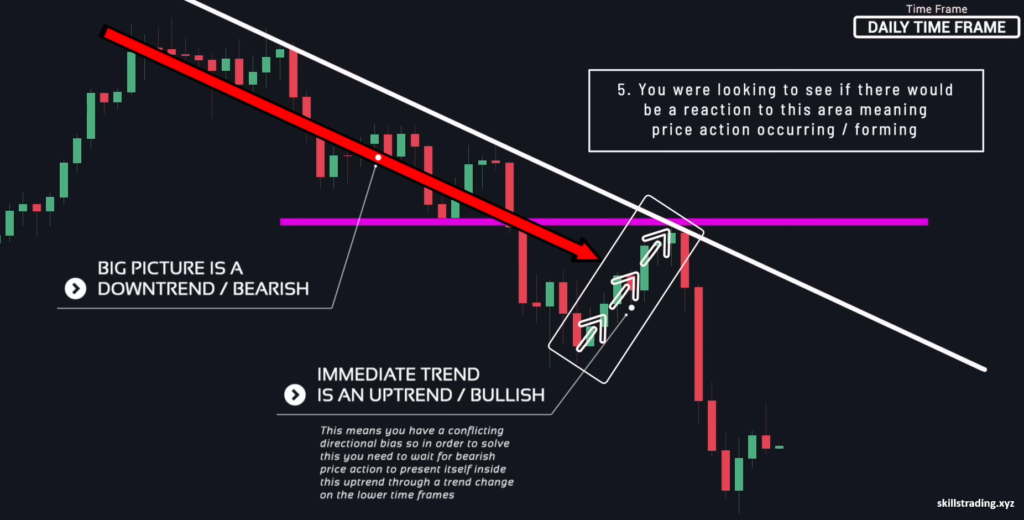
We received was a hanging candlestick, which shows the price is indeed reacting to the level, but again, a reaction does not mean a reversal will occur. So, here in is where you take your skill set up a notch. Since we had a candlestick reaction and formation at this access point, we then put a tight trend line in like this. The problem with tight trend lines is that they can often lead to fake-outs. So, how do we get around this problem? We use a lower time frame, specifically the four-hour time frame, so that we can see deeper into this immediate trend. Let ‘s place the four-hour time frame beside our daily time frame so you can see both simultaneously. Here we have both time frames side by side . This chart on the left is your daily time frame, meaning each candlestick represents one day. The chart on the right is the four-hour time frame.
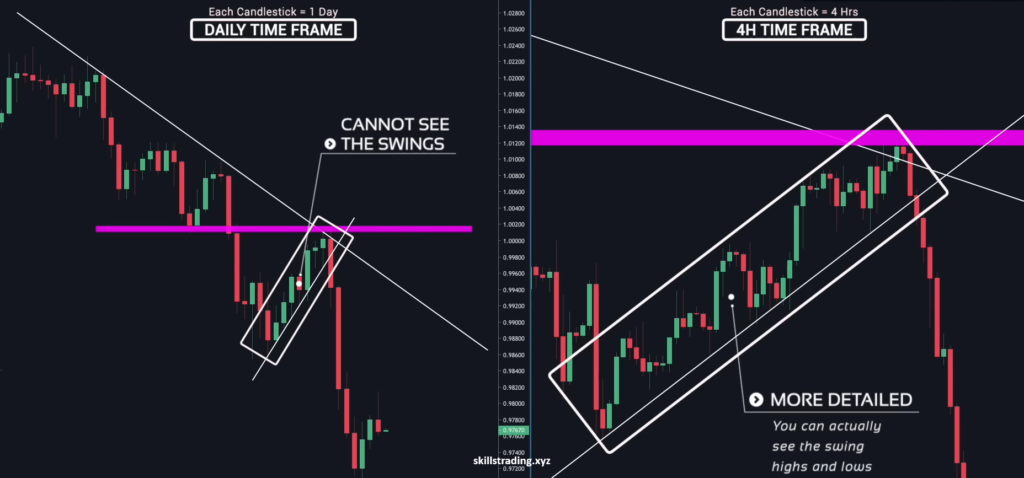
Meaning each candlestick represents four hours. Here is the resistance level on the daily time frame , and here is the same resistance level on the four-hour time frame. Here is the long-term trend line on the daily time frame, and here is the same long-term trend line on the four-hour time frame. Here is the short-term trend line on the daily time frame, and here is the same short-term trend line on the four-hour time frame. On the daily time frame’s short-term uptrend, you couldn’t see much, but now, in contrast, on the four-hour time frame, you can see so much more detail. You can actually see the swing highs and swing lows of price. Now that you understand multi-time frames, let’s recap this all. You had a big-picture downtrend, meaning a long-term bearish bias, but a short-term uptrend, meaning a short-term bullish bias. This means you were conflicted in your direction. Once price gets to your access point, an area of high confluence, you need price action for a trade short. Since you had a reaction to the access point through the hanging candle, you put a tight trend line in, but because on the daily time frame you cannot see deeper into the short-term uptrend, you needed to use the four-hour time frame to look deeper into the short-term uptrend. Here in the four-hour time frame, we were then looking for a trend change in this moving uptrend so that the short-term uptrend could turn bearish to match the long-term bearish downtrend. You have a run, a pullback, a run, a pullback, a run, a pullback, a run, a pullback, a run. This is your clear uptrend, because price is making higher highs and higher lows.
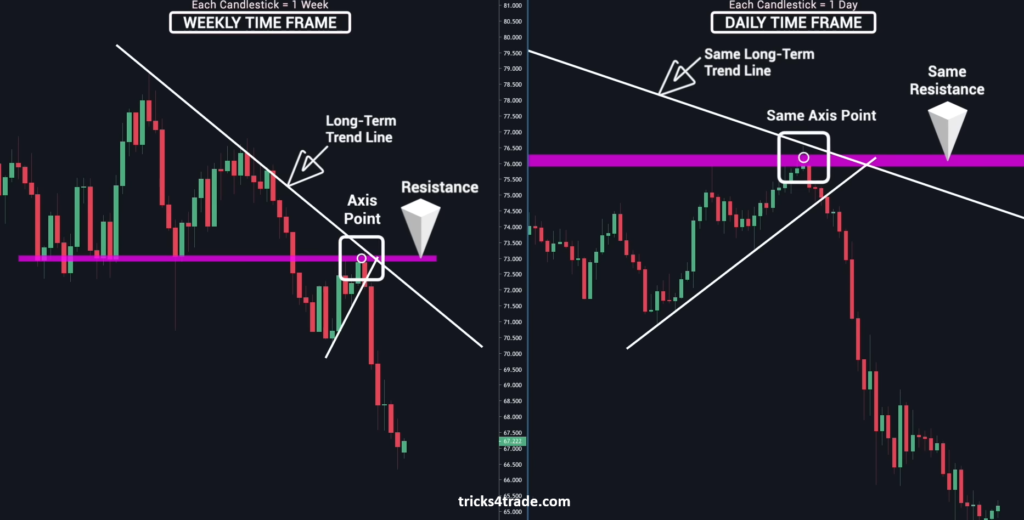
Here it is price then broke the short-term trend line, which is your bearish signal number one, and then made a lower low, your bearish signal number two. You now have bearish price action that entered the market, confirming that the short-term uptrend is over and that the longer-term downtrend can continue. Now, again, there are many ways to enter the market. You can enter right on the break through a momentum play using the lower timeframes, but the most important part is that your directional bias is confirmed now as down and short. So the key here is that this all occurred after the rejection and bounce from an area of high confluence; otherwise, you would have just had a trend line break , and that would be meaningless. Now, why is it important to use the four-hour time frame to look for a trend change after the rejection of your access point? Well, because without the trend change or trend line break, price could have easily done this instead and kept making higher highs and higher lows, continuing to respect the immediate short-term uptrend and breaking right through the long-term trend line. So let’s take this concept a step further. Now, in this example, we’ll show you another trick you can use if you are a longer-term trader: instead of using the daily time frame and the four-hour time frame, use the weekly in combination with the daily for swing trade entries. So this is the weekly time frame, and this is the daily time frame. Things you find on the weekly time frame hold more weight. So let’s go through the process again. Here in the weekly, you have the clear moving downtrend, as price is making lower highs and lower lows. So you want to trade with the overall big picture downtrend. You then have your trend line established through these two points where you had multiple rejections and your support turned resistance zone; here is your access point, an area of high confluence where the trend line and resistance crossed. Once price got here, you had two weekly candles that failed to break through, including a bearish red candle that rejected the weekly resistance level. Again, bounces and reactions don’t equal trades, so we draw a short-term trend line below the immediate trend. Now, in order to look for short trade entries, you need to confirm that the short-term uptrend is over, so we go to the daily time frame to look for a trend change in bearish price action inside of this current moving uptrend before looking for a short trade entry. Now here in the daily time frame, this is your same trend line from the weekly, the same resistance level from the weekly, the same access point from the weekly, and the same uptrend and trend line from the weekly. So here is the moving uptrend where you have a run , a pullback, a run before you had your break of the trend line and a lower low. You can start looking for short trade entries through a breakout or intraday entry .Again, the key here is that this all occurred after the rejection and bounce from an area of high confluence; otherwise, you would have just had a trend line break , and that would be meaningless.
True Top – Down Analysis :
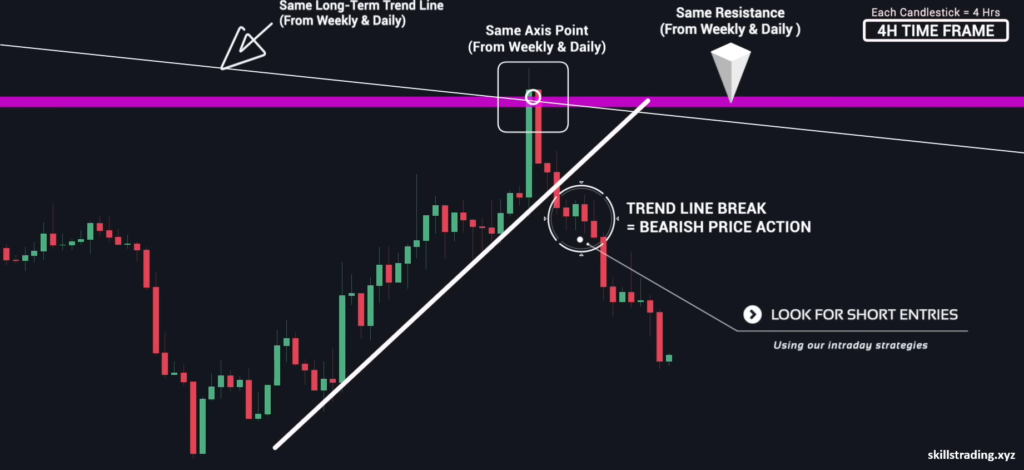
We will be using three timeframes, starting from the weekly to the daily and then to the four-hour timeframe. So, starting with the weekly, we were in a clear moving downtrend. Here was the weekly support turned resistance. Here was your trend line; here was your access point. Now, after you identified all your levels on the weekly, we jump to the daily. Here in the daily, you had a perfect long wick candle rejection of your access point, meaning a rejection of both the weekly trend line and weekly resistance. But again, still no trade unless we have confirmation that the short-term uptrend is over. So we go to the four-hour time frame to find a trend change on the short-term moving uptrend.
Here in the four-hour time frame, you have your weekly and daily resistance, weekly and daily trend line, and weekly and daily access point. You then have your short-term trend line here, and once price hits the access point and then breaks the short-term trend line, your short-term trend turns bearish and matches the long-term bearish downtrend. This is when you start looking for short trade entries, as all timeframes are bearish and confluent . So now that you understand how to use trend lines for trend trading
Trend lines and reversal trading.
The second way to use trend lines is through reversal trading -a reversal trading strategy with trend lines .Now, what you do is look for key price action patterns that have formed right before a trend line break .There are many kinds of price action patterns you can look for , such as wedges, triangles, and combining price action patterns with candlesticks and so forth; there are a lot .But for now, focus on these two: the double top or double bottom price action pattern and the trend change price action pattern. The double top or double bottom right before a trend line break. You first identify your trend line through these points here. Now, this is a clear moving uptrend, and the reason you want to identify a reversal price action pattern right before a trend line break is because you are going against the dominant uptrend. What this means is just a trend line break can often be a fake-out, so we like to pair a reversal pattern as an early signal of a possible big picture trend change, but then to pair it with the trend line break as confirmation to the price action pattern.
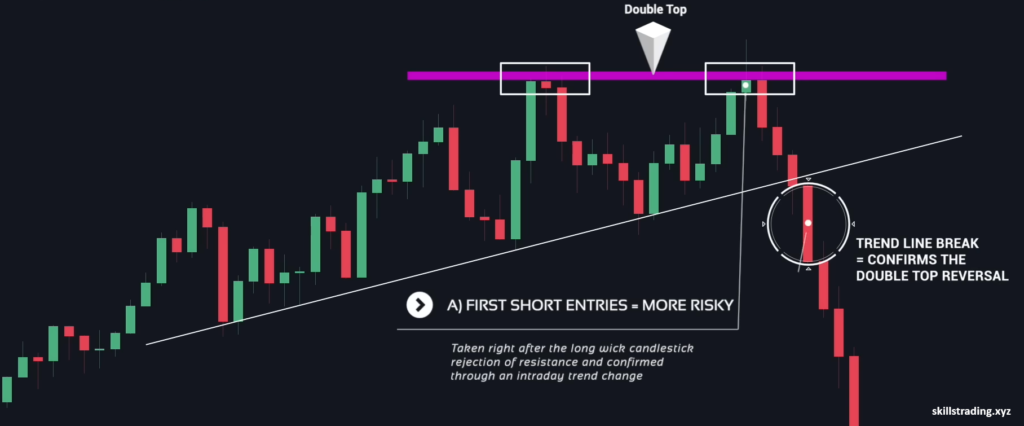
Double Top
What we got was this double top, which is a reversal pattern. Now, what does the double top tell us in terms of the uptrend? Well, it shows that price failed to make a higher high, which means this is a loss of momentum . Many traders would have taken a trade right at this long wick candle rejection of resistance and then waited for an intraday trend change. But for more secure traders, what you can do is wait for the trend line break to confirm that the uptrend is over. This is also a good example of why you should never chase trades, as you had trade opportunities right at the double top but also had opportunities to enter through a breakout strategy after the trend line break. Now, if this were a downtrend.
Double Bottom
The double bottom pattern we look for right before a trend line break is a trend change price action pattern . So, in order to spot a trend change, you look for these traits. Specifically, in an uptrend, you look for a lower high or a lower low to occur right before a trend line break, and in a downtrend, you look for a higher low or a higher high to occur right before a trend line break. So here is your moving uptrend, and we place our trend line below the uptrend connecting these points. Here you have your run, pullback, run, pullback, run, pullback, run, pullback. Now, at this point during the trend, you have a clear uptrend as price is making higher highs and higher lows. It is not until you have your lower high form here, which is when you would think to yourself that a lower high in an uptrend shows a loss of momentum. Once price then breaks the trend line, this confirms the trend change and shows bearish momentum entering the market. Again, the reason you want to look for reversal price action patterns before a trend line break is that it shows momentum loss, which is important when you go against a strong trend. So, let’s take this one step further and add in multi-time frame analysis to this concept. So here on the weekly time frame, what you would have first identified is that this was a moving downtrend. You then identified your trend line through these two points. Here, you would have identified this double bottom through these two points . So what you do is you want to jump down a time frame to the daily so that you can see more detail in the price action that is occurring within this double bottom and look for a trend change price movement. So here on the daily, you have your same trend line from the weekly and your same area of support from the weekly. Here is where the double bottom occurred on the weekly time frame.
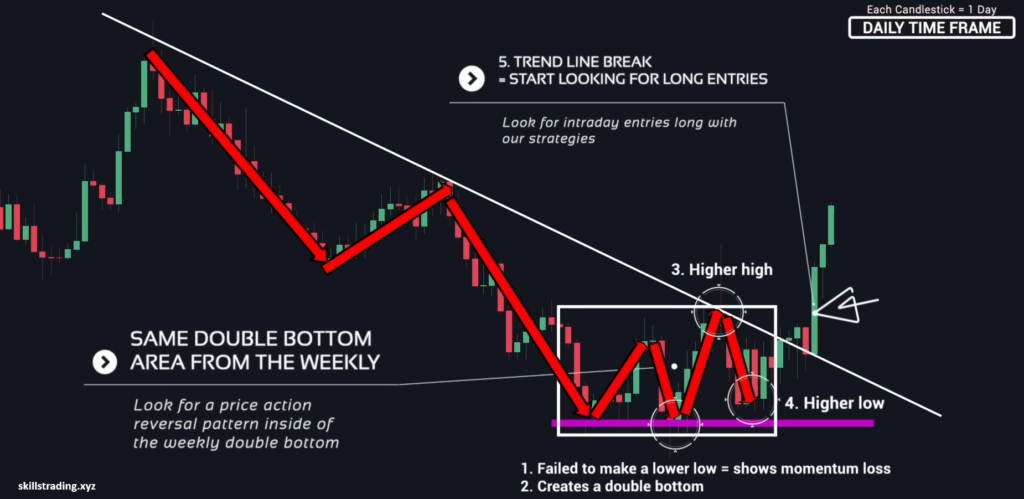
We see a lot more detail on this daily time frame. So again, in order to confirm the weekly double bottom reversal pattern, you want to also look for bullish price action that shows a trend change from a downtrend to an uptrend on this time frame, and you got this through the following things. You have your clear moving downtrend through the run, pullback, run, pullback, run. Price failed to make a lower low and made the same low, showing a loss of momentum. So you have a double bottom inside of a double bottom and then a higher high, which is the first sign of a possible trend change. You then had another higher low, which is another trend change signal. After you had your trend line break, you would then look for breakout entries through the intraday and lower time frames .
Understand, which is that trading comes down to the simple concept of trade quality , meaning there are low-quality trades and high-quality trades. The more you learn things, the more you can see, which then allows you to choose between okay trades and high-quality trades.

What you want to do is take high-quality trades, and knowing the concepts we have introduced in different strategies in our previous articles for our binary trading India traders, It will help you build towards that endgame . Increasing trade quality is knowing when not to take trades, which is just as important as knowing when to take trades. So if you want to learn more about our trade entry strategies, head on over to our website. Comment below with your thoughts and what kind of topics you want us to cover. Just let us know you want more articles/ strategies.
Pingback: 4 Top Sureshot Pattern in Quotex and Tradowix - skillstrading.xyz